


In the competitive scene of the MOBA developed by Riot Games, connection stability has become a key technical factor for maintaining consistency in ranked matches.
Even small millisecond fluctuations can directly affect game awareness, reaction time, and mechanical precision. The ping represents the time required for information to travel between the player’s computer and the game servers.
This value is measured in milliseconds (ms). In general, connections below 50 ms provide a smoother gameplay experience. Between 50 ms and 100 ms, it is still possible to play with moderate stability.
Above that threshold, delays become noticeable and start affecting overall performance during matches. In competitive titles such as League of Legends, high latency can cause delays in skill activation, difficulties during objective fights, and reduced precision in situations that require fast responses.
The issue becomes even more evident during team fights, when the amount of data exchanged with the server increases.
Measures can help reduce ping in League of Legends
Some practices may improve connection stability:
• Use an Ethernet cable instead of Wi-Fi
• Close background applications
• Restart the router
• Update network drivers
• Avoid downloads during matches
In addition to these basic actions, home network configuration also impacts performance. In environments with many connected devices, bandwidth competition may increase latency and cause instability.
Features such as QoS (Quality of Service) help prioritize game traffic, reducing interference caused by other devices connected to the network.
Try a free solution to reduce ping in League of Legends
For players dealing with constant instability, route optimization tools have emerged as an alternative to improve connection quality.
Here’s how to use NoPing:
• Create an account to test it for free
• Download and install the program
• Open the software and search for League of Legends

• Click “Optimize Automatically”
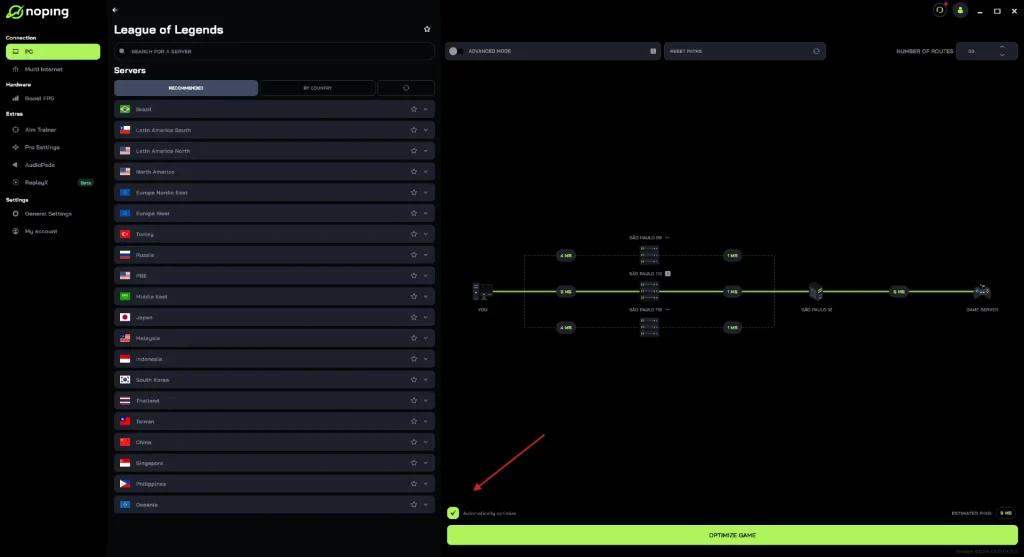
• Then select “Optimize Game” and launch the match
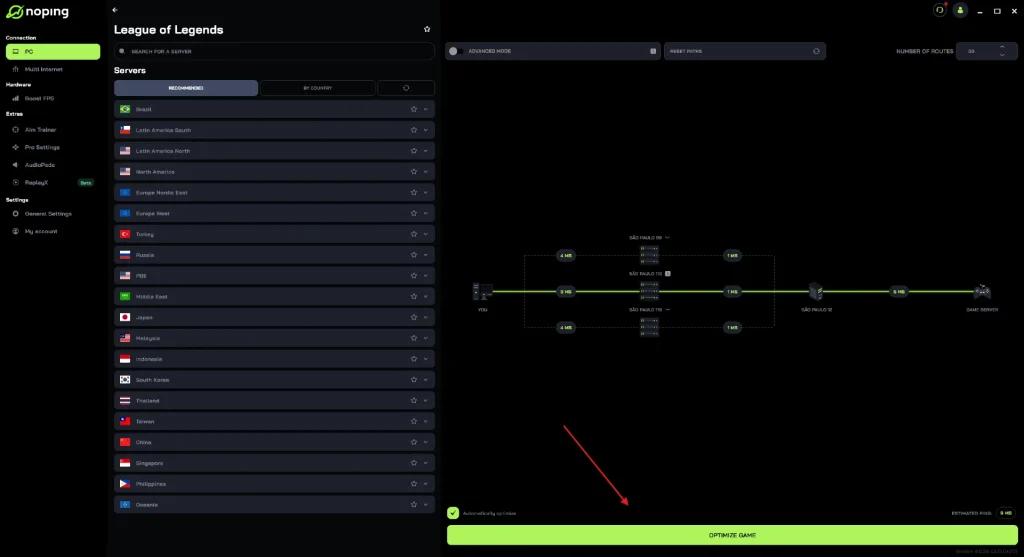
The technology identifies faster routes to the servers, potentially reducing ping and improving connection stability.
Real-time monitoring helps identify issues
League of Legends itself offers network indicators during matches. The feature allows players to monitor ping in real time and identify connection fluctuations.
This monitoring helps players determine whether the issue is related to the local network, the internet provider, or the game servers.