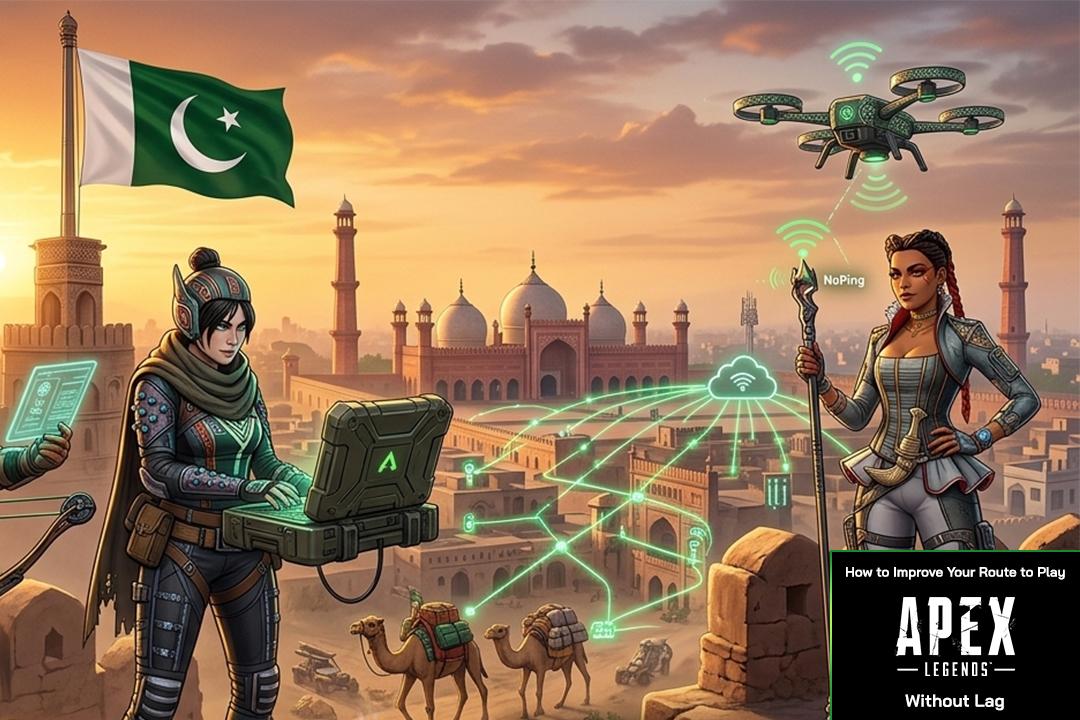
The Routing Paradox: 1,100km Away but 150ms of Ping
Lahore to Mumbai is 1,100 kilometers. Frankfurt to Mumbai is over 6,000 kilometers. Yet a Pakistani Apex Legends player in Lahore often gets the same ping to both servers — sometimes Mumbai is worse. This routing paradox defines the Pakistan Apex experience, and at 20Hz tick rate, it turns what should be a geographic advantage into a no-reg disaster.
On the fiber optic cables that physically connect Karachi to Mumbai, data should travel in 40-70ms round trip. The infrastructure exists. Multiple submarine cables — IMEWE, SMW5, AAE-1 — land in Karachi and connect directly to Mumbai. Pakistan should have the best ping to Mumbai servers of almost any country in the region.
Instead, Pakistani ISPs route traffic through Singapore, through European exchanges, through Middle Eastern transit points — anywhere except the direct path. Packets from Lahore that should take a 1,100km trip to Mumbai instead travel 10,000km or more through international exchanges before arriving. The geographic advantage is wasted by routing inefficiency.
Pakistan did not lose much when Bahrain servers went offline in March 2026. Bahrain was always 60-90ms from Pakistan — not great, and the queues were empty anyway. Most Pakistani Apex players were already on EU servers at 80-110ms. The
REAL story is not what Pakistan lost. The
REAL story is that Mumbai servers — at 40-70ms with proper routing — should be the best option available. But broken ISP routing turns 40-70ms into 100-150ms.
At 20Hz tick rate, that routing failure means the difference between competitive gameplay and constant no-regs. This is a routing fix article. The solution is specific and actionable.
Why Pakistan-to-Mumbai Routing Is Broken
Understanding why Pakistani ISPs route inefficiently to Mumbai requires looking at the infrastructure and the business decisions behind it.
PTCL's International Routing Problem
PTCL (Pakistan Telecommunication Company Limited) is the dominant fixed-line ISP in Pakistan, carrying the majority of the country's internet traffic. PTCL peers at a limited number of international exchanges. When traffic needs to reach Mumbai, PTCL's routing tables often send it through Singapore, through European transit, or through Middle Eastern exchanges — rather than the direct submarine cable path from Karachi.
This is not because the direct path does not exist. The physical cables connecting Karachi to Mumbai are present and functional. The issue is peering agreements, transit costs, and routing table configurations. PTCL's default routes prioritize their existing transit arrangements over the most geographically efficient path.
The result: a Lahore gamer's Apex packets travel Lahore to Karachi (domestic backbone) to an international exchange in Singapore (3,500km detour) to Mumbai (another 5,000km back) — totaling 8,500+ km instead of the 1,100km direct path. The latency balloons from the ideal 40-70ms to 100-150ms.
The Cable Infrastructure Exists
This is the cruel irony. Pakistan has excellent submarine cable connectivity to India:
- IMEWE (India-Middle East-Western Europe): Lands in Karachi, connects to Mumbai
- SMW5 (South East Asia-Middle East-Western Europe 5): Routes through Pakistan
- AAE-1 (Asia-Africa-Europe 1): Connects through the region
The physical infrastructure to support 40-70ms Pakistan-to-Mumbai ping is built, operational, and carrying traffic. It is just not carrying Pakistani gaming traffic efficiently because ISP routing tables send packets on detours.
Nayatel and StormFiber
Pakistan's fiber ISPs — Nayatel in Lahore/Islamabad and StormFiber in Karachi/Lahore — have better routing than PTCL in many cases. Their international peering is more direct. But even these providers are limited by the same international exchange constraints. A Nayatel user might see 80-120ms to Mumbai instead of PTCL's 100-150ms — better, but still far from the geographic potential.
StormFiber users in Karachi, being physically closest to the submarine cable landing points, sometimes get the best baseline — 70-110ms to Mumbai. Still double what the infrastructure supports.
The 4G Reality: Pakistan has no 5G deployment. Mobile gaming is on 4G, which adds 30-50ms of radio-layer latency on top of routing delays. Total ping from a 4G connection to Mumbai: 130-200ms. At 20Hz tick rate, ranked Apex on mobile Pakistani internet is not viable.
Why 20Hz Makes Pakistan's Routing Problem Catastrophic
The routing problem is fixable. NoPing proves that every day for Pakistani players. But understanding why fixing it matters requires understanding the 20Hz multiplier.
Scenario 1: Pakistan with Ideal Routing (40-70ms to Mumbai)
- Desync window at 20Hz: 90-120ms
- No-reg frequency: 10-15% on fast-moving targets
- Armor swap reliability: functional with minor delay
- Door plays: reliable
- Competitive viability: Diamond+ achievable
Scenario 2: Pakistan with Current Routing (100-150ms to Mumbai)
- Desync window at 20Hz: 150-200ms
- No-reg frequency: 40-55% on fast-moving targets
- Armor swap reliability: fails 1 in 3 attempts
- Door plays: useless — 3 ticks of open door
- Movement abilities: die during activation regularly
Comparison: Same Ping, Different Tick Rates
| Game | Pakistan Mumbai Ping (current) | Tick Rate | Desync | Experience |
|---|
| Apex | 130ms | 20Hz | ~180ms | Unplayable competitive |
| CS2 | 130ms | 64Hz | ~146ms | Poor but functional |
| Valorant | 130ms | 128Hz | ~138ms | Noticeable but manageable |
NoPing: Pakistan's Routing Fix
Pakistan's iconic truck art features elaborately decorated trucks traversing the country's highways. The art does not make the truck faster if the road is broken. Pakistan's internet routing is like a beautifully painted truck on a potholed highway — the infrastructure looks connected on paper, but the actual routing takes detours through distant exchanges.
NoPing is the shortcut that local truck drivers know. The direct road between cities that bypasses the congested highway. For Pakistan to Mumbai, that direct road exists — NoPing finds it.
Multi-Path = Direct Route Discovery
NoPing's servers act as optimized waypoints that bypass broken ISP routing. Instead of PTCL's default path through Singapore or European exchanges, NoPing routes through optimized transit that actually uses the direct submarine cable infrastructure between Karachi and Mumbai.
The physical cables support 40-70ms. NoPing enables Pakistani players to approach that number — typically achieving
50-80ms to Mumbai. The routing fix alone can deliver a 40-60ms improvement for PTCL users.
Connection Bonding for PTCL Instability
PTCL connections are known for packet loss spikes and mid-session routing changes. NoPing bonds multiple network paths together. If PTCL's primary route drops packets or shifts, the secondary bonded path catches them. Your game session survives routing changes that would otherwise disconnect you and trigger Apex's ranked abandon penalties.
Anti-Cheat Compatibility: NoPing operates at the network layer only. EA/Respawn's anti-cheat system monitors game memory and processes. NoPing does not touch the Apex client — it optimizes how your packets travel through the internet. No risk.
ISP-Specific Guide for Pakistani Apex Players
| ISP | Mumbai (raw) | Mumbai (NoPing) | Improvement | Jitter (raw) | Jitter (NoPing) |
|---|
| PTCL | 100-150ms | 60-80ms | 40-60ms | ±20-35ms | ±6-10ms |
| Nayatel | 80-120ms | 50-75ms | 20-35ms | ±12-20ms | ±5-8ms |
| StormFiber | 70-110ms | 45-70ms | 20-35ms | ±10-18ms | ±4-7ms |
| 4G Mobile | 130-200ms | 100-150ms | 30-50ms | ±30-50ms | ±15-25ms |
Real Impact at 20Hz: Pakistan Before and After NoPing
| Mechanic | PTCL default (130ms/20Hz) | NoPing optimized (65ms/20Hz) |
|---|
| R-99 one-clip | 40-55% no-reg rate | 10-15% no-reg rate |
| Door close for cover | Useless — 3 ticks open | Functional — 1 tick delay |
| Armor swap | Fails 1 in 3 attempts | Reliable |
| Wraith phase | Die during activation regularly | Ability works as designed |
| Ranked stability | PTCL drops cause penalties | Bonded connection stays stable |
| Competitive ceiling | Platinum | Diamond+ |
Setup Guide: NoPing for Apex Legends in Pakistan
Step 1: Download NoPing
NoPing download page
Step 2: Select Apex Legends
Step 3: Choose Server — Mumbai-Optimized Node
This is the critical selection for Pakistan. Choose the NoPing node optimized for the Mumbai route to bypass inefficient ISP routing.
Step 4: Launch Apex Through NoPing
Step 5: Check Data Center Ping
In the Apex main menu, access the data center selector. You should see a dramatic improvement — often 40-60ms lower than your baseline for PTCL users.
Step 6: Test in the Firing Range
The hit registration difference will be immediately obvious. Spray an R-99 at the moving targets; shots that previously no-regged will now connect.
Frequently Asked Questions
Why is my ping to Mumbai so high from Pakistan?
Pakistani ISPs — especially PTCL — route traffic through inefficient paths like Singapore or Europe. NoPing bypasses these routes using optimized transit that utilizes the direct Karachi-Mumbai submarine cables.
Why does Apex have worse hit registration than Valorant from Pakistan?
Tick rate. Apex runs at 20Hz (updates every 50ms). With 130ms ping, the desync window reaches 180ms. Valorant’s 128Hz tick rate (7.8ms updates) makes the same ping much more manageable.
Will NoPing get me banned?
No. NoPing works at the network layer and does not modify game files. It is invisible to anti-cheat and functionally identical to having better ISP routing.
Should I use a gaming VPN instead of NoPing?
No. VPNs add encryption overhead and cannot bond connections. NoPing specifically targets the Pakistan-to-Mumbai routing inefficiency without the latency penalty of a VPN.
Conclusion: The Road Is Short — Fix the Routing
The distance from Pakistan to Mumbai is short — 1,100km of submarine cable that supports 40-70ms ping. The routing just needs fixing. NoPing is the shortcut that ensures your packets take the direct path. At 20Hz, that shortcut is the difference between no-regs deciding your fights and your skill deciding them.
Start your NoPing free trial — get the Mumbai ping you deserve