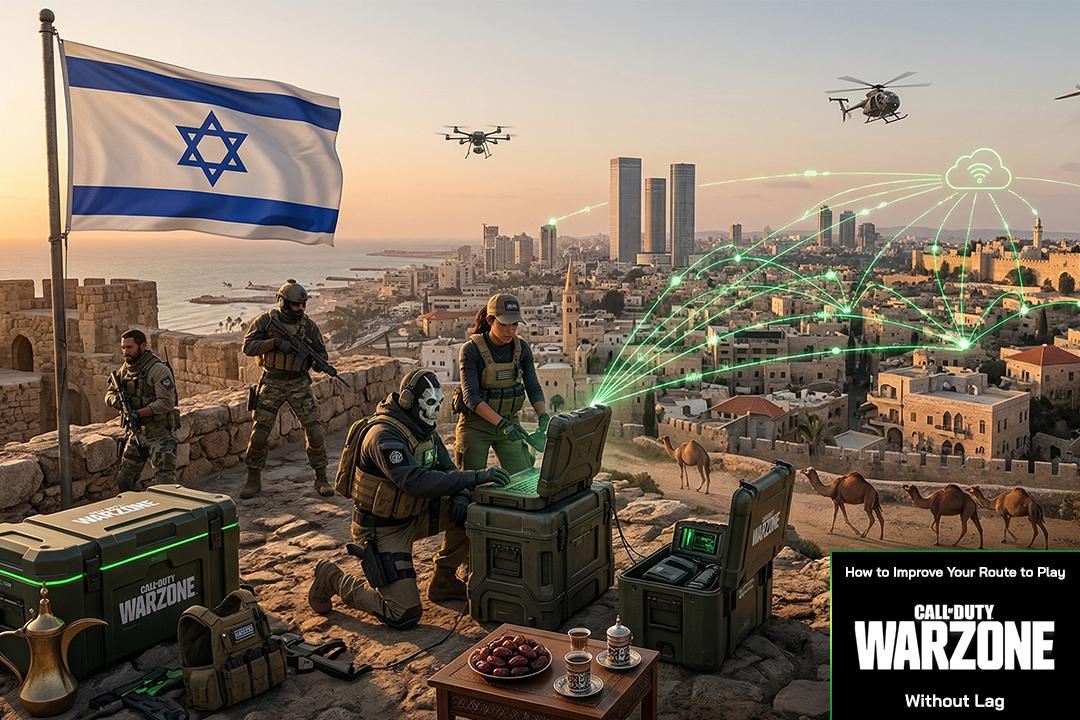
Israeli CoD Players Are on EU Servers — But the Ping Gap Still Hurts
Israeli Warzone players did not face the dramatic ping explosion that Gulf countries experienced in March 2026. Going from 35-55ms on Bahrain servers to 60-80ms on EU servers is survivable. It is playable. You can still queue matches, compete in lobbies, and progress through ranked play.
But survivable is not competitive. And in Call of Duty — a game where Time-to-Kill sits at 200-350ms and the gulag mechanic distills combat to pure 1v1 reaction speed — every millisecond of disadvantage accumulates across hundreds of gunfights into measurable rank stagnation.
At 60-80ms on EU servers, Israeli players face opponents sitting at 10-30ms with home-server advantage. That 30-50ms gap might not produce the dramatic lag spikes and visible desync that Gulf players experience, but it creates a persistent, consistent disadvantage in every engagement. You are always slightly behind. Your shots register slightly late. Your movement techniques are slightly less responsive. Your gulag outcomes skew slightly against you.
Over hundreds of matches, "slightly" compounds into real consequences. K/D ratios deflate. Ranked progression stalls. Gulag win rates drop 10-15 percentage points.
This article is not about disaster recovery. Israeli CoD players are not in crisis mode. This is about optimization — gaining every competitive edge that routing efficiency can provide. Both Warzone at 20-40Hz and MWIII Multiplayer at 60Hz are affected by the same EU routing, and both respond to the same optimization approach.
NoPing's multi-path routing shaves 15-20ms off EU server connections by finding the most efficient Mediterranean cable paths. That reduction brings Israeli players from chronic disadvantage to competitive parity. And it is fully compatible with RICOCHET Anti-Cheat.
NoPing download page — noping.com
The Server Shift — How Israel Ended Up on EU Lobbies
Israel's Call of Duty routing history is straightforward. Before March 2026, Israeli players connected to Demonware's infrastructure on AWS ME-SOUTH-1 in Bahrain. The Mediterranean-to-Gulf routing delivered 35-55ms — respectable ping that allowed competitive play without significant disadvantage.
When infrastructure damage degraded Bahrain operations in March 2026, CoD's matchmaking algorithm redirected Israeli players to EU servers in Western Europe. Israel's geographic position — on the eastern Mediterranean coast — means it has well-established submarine cable connectivity to Europe. The Mediterranean cables provide a reasonable, if suboptimal, path to EU data centers.
Current ping sits at 60-80ms. This is not catastrophic. But it represents a meaningful increase from the 35-55ms Bahrain experience, and more importantly, it places Israeli players at a consistent disadvantage against Western European opponents who connect at 10-30ms.
The matchmaking auto-redirect is automatic and not configurable by the player. Demonware's system detects degraded Bahrain connectivity and routes to the next viable region. For Israel, EU is the logical alternative given the Mediterranean cable infrastructure.
Two Tick Rates, One Problem
Warzone operates at 20-40Hz tick rate. At 60-80ms, you are 1-4 server ticks behind opponents at 15ms. In large 150-player lobbies where multiple engagements happen rapidly, this tick disadvantage manifests as slightly late hit registration and slightly delayed position updates. Noticeable in gunfights, decisive in close encounters.
MWIII Multiplayer runs at 60Hz. At 60-80ms, you are 4-5 ticks behind. In the faster-paced 6v6 and 12v12 formats with their aggressive Time-to-Kill, being 4-5 ticks behind is a significant competitive handicap. EU players at 15ms experience the game with substantially more responsive netcode.
Both modes are playable at 60-80ms. Both modes are consistently disadvantaged against home-server EU opponents. The optimization opportunity is real.
What 60-80ms on EU Servers Means for Your CoD Matches
The impacts at 60-80ms are more subtle than the 110-140ms problems Gulf players face, but they are persistent and they compound.
Gulag — The Smallest Margins
At the highest skill levels, gulag fights are decided by margins of 10-30 milliseconds. The gulag strips away every variable except aim, positioning, and connection speed. Same loadout, same health, same arena. When an EU player sits at 15ms and an Israeli player at 70ms, that 55ms gap means the EU player's actions register on the server faster in every single exchange.
This is not a guaranteed loss. At 55ms disadvantage, skill can still overcome connection. But it tips the odds. Over 50 gulag encounters, a 55ms ping gap translates to approximately 10-15% lower win rate compared to what the same player would achieve at equal ping. For competitive players who track their stats, that is a visible and frustrating discrepancy.
MWIII's Fast TTK Amplifies the Gap
CoD's Time-to-Kill at 200-350ms means 60-80ms of latency consumes 20-40% of the available reaction window. You see the enemy slightly late. Their damage registers slightly early on the server. You die slightly more often in trades that should be 50-50.
No single gunfight feels dramatically unfair. But across an evening session of 15-20 matches, the cumulative effect is measurable. Rank progression slows. K/D trends downward by a few percentage points. The competitive edge that separates ranks erodes.
Movement and Warzone Mechanics
Slide canceling, bunny hopping, and dropshotting are less crisp at 60-80ms than at 30ms. The techniques still function, but the server-client sync is slightly looser. Advanced movement plays that rely on frame-perfect timing become less reliable. A slide cancel that perfectly evades a bullet at 20ms might leave your server-side hitbox exposed for an extra fraction of a second at 70ms — enough for an enemy bullet to connect.
Bunny hopping is designed to break enemy aim assist tracking by rapidly changing your vertical position. At elevated ping, the server version of your movement is smoother and less erratic than what your screen shows. The enemy's aim assist tracks the smoother server-side movement, partially negating the evasive benefit. Dropshotting — going prone while firing — suffers from hitbox desync where your server-side model remains upright fractionally longer than your client animation.
YY weapon swap canceling and quickscope timing — frame-perfect techniques that skilled players rely on — become inconsistent at 60-80ms. The tight timing windows required for these techniques have less margin for error when every input takes an extra 30-50ms to register on the server.
In Warzone specifically, plate insertion has a small but noticeable delay. You complete the animation and believe your armor is active, but the server may not have registered the plate for another 60-80ms. Buy station interactions take marginally longer — a server handshake at 70ms adds delay that exposes you at contested buy locations. Loadout drops require standing in position slightly longer to complete the pickup interaction. Gas zone damage is server-authoritative, meaning you can take damage slightly before your screen shows you inside the gas boundary.
Killstreak confirmations — UAV, cluster strike, precision airstrike — arrive a fraction late during fast endgames. When you are calling in a precision airstrike during the final circle with three teams left, that fraction of a second can be the difference between eliminating an enemy team and watching your streak deploy after they have already repositioned.
SBMM pools Israeli players with EU opponents who have better ping. The matchmaking system does not adjust for latency differential — it groups by performance metrics. When your performance is consistently degraded by 30-50ms disadvantage, SBMM creates a chronic cycle of playing slightly above your apparent skill level. Your rating deflates because your gunfight win rate is suppressed by connection quality. The system sees a player performing at a certain level and matches accordingly — unaware that the same player would perform measurably better at equal ping.
Better Internet Won't Fix It — Better Routing Will
Israeli ISPs deliver solid internet infrastructure. Bezeq at roughly 35% market share, HOT at about 30%, Partner at around 20%, and Cellcom at approximately 15% all provide reliable FTTH and broadband services. The local connection quality is not the issue.
The problem lies in how packets traverse Mediterranean submarine cables to reach EU servers. Different cable routes have different latencies depending on their physical path, the number of intermediate nodes, and current congestion levels. Your ISP selects the cable route based on peering agreements and traffic management policies — not gaming latency optimization.
Different Israeli ISPs may use different submarine cable routes to reach the same EU destination. This means there are multiple potential paths of varying efficiency. The fastest path might not be the one your ISP uses by default.
Bandwidth upgrades do not help. A 500Mbps connection and a 1Gbps connection follow the same cable route and deliver the same ping. VPNs add latency and create unnecessary RICOCHET concerns. DNS changes do not affect game traffic routing.
The optimization opportunity is in routing — finding the fastest Mediterranean cable path out of the multiple options that exist between Israel and Western European servers.
How NoPing Optimizes Your EU Connection for CoD
NoPing takes a systematic approach to finding the fastest available route between your PC in Israel and Demonware's EU servers.
Multi-Path Routing — The Iron Dome Approach
Israel's Iron Dome defense system operates on a principle of layered, multi-angle interception. Multiple tracking systems work simultaneously, calculating trajectories from different angles, ensuring threats are intercepted via the optimal path. The system succeeds not through a single solution but through redundant, parallel analysis that selects the best option in real-time.
NoPing applies this same multi-layered approach to network routing. It establishes multiple simultaneous paths from your connection to EU servers, each traversing different Mediterranean cable routes. Some paths may route through cables landing in southern Europe. Others may use routes through Cyprus or Crete. Each path has different latency characteristics depending on cable length, intermediate hops, and current utilization.
NoPing measures all active paths continuously. At every moment, your game packets travel on whichever path currently offers the lowest latency. If one cable route experiences congestion during European peak hours, your packets are already on an alternative route that avoids the bottleneck.
Multi-Internet Bonding — Bezeq + HOT Combined
Bonding two Israeli ISPs — for example Bezeq and HOT — doubles the available routing paths. Different ISPs may use different submarine cable landings and different peering arrangements with European networks. More paths mean more opportunities for NoPing to find optimal routing.
Bonding also provides failover protection for long Warzone sessions. A 150-player match lasting 25 minutes is protected against single-ISP disruptions. If one connection hiccups, the other maintains the session.
RICOCHET Anti-Cheat — Fully Compatible
NoPing operates at the network routing level exclusively. It optimizes how your internet packets travel from Israel to EU servers. It does not inject code into Call of Duty, does not modify game files, does not hook into game processes, and does not interact with RICOCHET's kernel driver.
RICOCHET monitors game memory and process integrity. NoPing operates entirely outside that domain. Thousands of CoD players use NoPing daily without any anti-cheat issues.
Realistic expectations for Israeli players:
| City | Without NoPing | With NoPing |
| Tel Aviv | 60-80ms | 45-60ms |
| Haifa | 60-75ms | 45-60ms |
| Jerusalem | 65-85ms | 50-65ms |
The improvement of 15-20ms may seem modest compared to the 40-60ms reductions Gulf players see. But in CoD's fast TTK environment, every millisecond matters. Going from 70ms to 50ms narrows the gap against EU players at 15ms from a 55ms disadvantage to a 35ms disadvantage — a reduction that meaningfully changes gunfight and gulag outcomes.
How to Set Up NoPing for Call of Duty in Israel
Setup is quick and practical:
- Download NoPing from noping.com.
- Create your account or log in.
- Select your game: "Call of Duty: Warzone" or "Call of Duty: Modern Warfare III."
- NoPing auto-detects the optimal EU server route, testing multiple Mediterranean cable paths.
- Click "Optimize." NoPing selects the fastest routing combination.
- Launch Call of Duty normally through Battle.net or Steam.
- Check ping in-game via telemetry overlay or scoreboard.
Tip: If you have both Bezeq and HOT (or Partner/Cellcom as secondary), connect both before launching NoPing. The dual-ISP configuration maximizes path diversity through Mediterranean cables, giving NoPing more routing options to test and optimize.
Ranked Play tip: Launch NoPing before starting the game. The matchmaking ping test during lobby search will reflect your optimized connection, potentially influencing lobby placement for more favorable matchmaking.
Frequently Asked Questions — Call of Duty Ping in Israel
Q: Is NoPing safe with RICOCHET Anti-Cheat?
A: Yes. NoPing is a network route optimizer. It does not touch the game client or RICOCHET's kernel driver. It operates like choosing a faster highway —