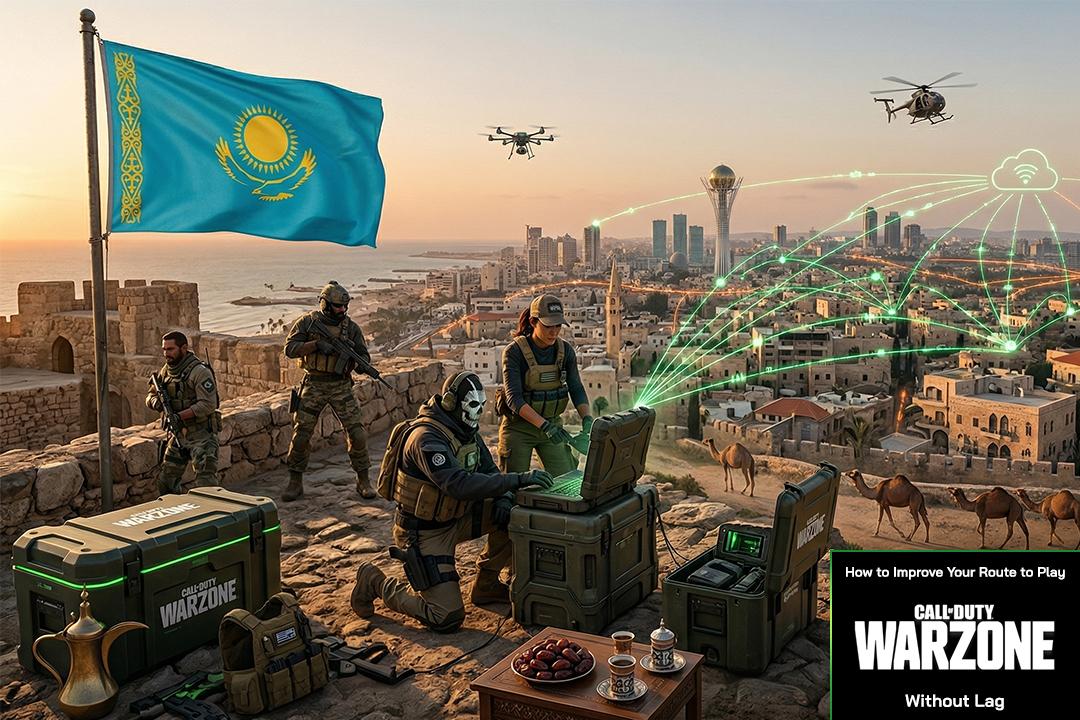
Kazakhstan's CoD Players Are Always Between Servers — Here's How to Optimize
Kazakhstan sits at one of the great crossroads of Central Asia — geographically between EU servers to the west and CIS servers to the north, not ideally close to either. While Gulf Call of Duty players are managing a server crisis that exploded overnight, Kazakh players face a different challenge: a chronic, structural ping disadvantage that has always been there.
EU servers — the primary destination for CoD matchmaking in Kazakhstan — deliver 65-90ms from Almaty and 70-100ms from Astana. This is not a crisis number. It has been the baseline for as long as most Kazakh players can remember. CIS (Russian) servers occasionally appear at 50-70ms, but CoD's matchmaking algorithm does not consistently route to them.
The March 2026 Bahrain infrastructure damage did not dramatically change Kazakhstan's situation. Kazakh players were already on EU servers. They were never connected to Middle East infrastructure. The crisis affecting Gulf countries passed largely unnoticed in Almaty gaming rooms.
But the underlying problem remains: every gulag fight is played with a 35-60ms disadvantage against EU opponents at 10-30ms. Every MWIII Multiplayer gunfight starts with your reaction window already 20-40% consumed by latency. Every ranked match reflects not just your skill but your distance from the server.
You cannot move Kazakhstan closer to Western Europe. But you can optimize the routing path. NoPing's multi-path routing consistently shaves 15-25ms off the EU connection — moving 65-90ms to 50-70ms. In CoD's fast TTK environment, where every millisecond translates to competitive advantage, that reduction changes outcomes.
This is not crisis recovery. This is permanent optimization for a structural challenge. Both Warzone at 20-40Hz and MWIII Multiplayer at 60Hz benefit equally. And NoPing is fully compatible with RICOCHET Anti-Cheat.
NoPing download page — noping.com
Why Kazakhstan Gets 65-90ms to CoD EU Servers
Understanding why the ping sits where it does helps explain what can and cannot be optimized.
Kazakhstan's geographic position places Almaty approximately 4,000-5,000 kilometers from Western European data centers. This physical distance sets a minimum latency floor — the speed of light through fiber optic cable determines the absolute fastest a signal can travel. But the actual ping is higher than the theoretical minimum because of how ISPs route traffic.
Kazakhtelecom, the state-owned ISP commanding roughly 50% of the market, routes international traffic primarily through Moscow-based international links. This adds intermediate hops through Russian backbone infrastructure. Beeline Kazakhstan, holding about 25% of the market, uses different routing but still typically passes through Russian infrastructure to reach Western Europe.
The result is consistent 65-90ms from Almaty and 70-100ms from Astana. During Russian internet peak hours, these numbers can spike higher as backbone congestion increases. The routing is functional but not optimized for gaming.
The CIS Option
Some CoD matchmaking pools include CIS (Russian) servers. When available, these deliver 50-70ms from Almaty — Moscow servers sit at approximately 50ms distance. This would be ideal as the primary connection, but CoD's matchmaking algorithm does not consistently offer CIS as an option. EU remains the primary destination, and players cannot manually select server regions in Call of Duty.
When CIS servers are available, the experience is noticeably better. The 15-20ms reduction from 70ms to 50ms is meaningful in CoD's fast-TTK environment. But the inconsistency means players cannot rely on CIS availability.
Two Tick Rates, Same Geographic Challenge
Warzone at 20-40Hz: at 65-90ms, you are 1-4 server ticks behind EU opponents at 15-25ms. Noticeable in gunfights, meaningful in close encounters, occasionally decisive in gulag matchups.
MWIII Multiplayer at 60Hz: at 65-90ms, you are 4-5 ticks behind. In CoD's 200-350ms TTK, being 4-5 ticks behind represents a significant competitive handicap in every engagement.
At an optimized 50-70ms, the tick disadvantage drops meaningfully. Warzone gaps narrow to 1-2 ticks. MWIII closes to 2-4 ticks. The game does not become lag-free, but it becomes fair enough that skill dominates connection quality in most encounters.
What 65-90ms Does to Every Warzone and MWIII Match
The impacts of 65-90ms are not dramatic. You will not see obvious rubber-banding or visible desync. But they are persistent, and in a game where margins between winning and losing are measured in milliseconds, persistence matters.
Gulag — Permanently Disadvantaged
Every gulag encounter against an EU player is a 35-60ms disadvantage. The EU opponent's trigger pull registers on the server before yours, their position updates are fresher, and their hit registration is slightly more accurate.
This does not mean you lose every gulag. At 65-90ms, skill still plays the primary role. But the odds are tilted — consistently, across every gulag encounter, across every session. Over time, this tilt manifests as a measurable win rate reduction. Kazakh players who would maintain 55% gulag win rates at equal ping sit at 45-50% instead. The gap is not catastrophic, but it is real and it is permanent until the routing changes.
TTK and Gunfight Registration
CoD's 200-350ms Time-to-Kill at 65-90ms means the first 20-40% of every gunfight is consumed by network latency. You are not dramatically disadvantaged — but you are consistently, slightly behind. The enemy's bullets register marginally before yours. Your damage is confirmed marginally later.
Over thousands of gunfights across weeks and months of play, this slight disadvantage compounds into lower K/D ratios and rank stagnation. The difference between Diamond and Crimson rank, between a 1.2 K/D and a 1.0 K/D, often comes down to exactly this kind of persistent marginal disadvantage.
The 15-25ms improvement from NoPing changes "slightly behind" to "competitive." At 50-70ms, the disadvantage against EU players narrows enough that individual skill reasserts itself as the dominant factor.
Movement and Warzone Mechanics
Slide canceling works at 65-90ms but is slightly less crisp than at 30ms. The server-client synchronization has enough slack that advanced movement techniques are functional but not frame-perfect. Over many engagements, the slight imprecision accumulates.
Warzone plate insertions register with minor delay. Killstreak confirmations arrive slightly late. Buy station interactions take marginally longer. None of these are game-breaking individually, but together they create a persistent friction that home-server EU players never experience.
SBMM pools Kazakh players with EU opponents who have inherently better ping. The matchmaking system does not adjust for geographic disadvantage — it groups by performance. When performance is chronically suppressed by 35-60ms handicap, SBMM creates a cycle of rating deflation that does not reflect true skill.
Switching ISPs and VPNs Won't Fix Kazakhstan's CoD Ping
Kazakhtelecom and Beeline Kazakhstan both route through similar Russian backbone infrastructure. Switching between them may shift your experience by a few milliseconds, but the fundamental routing path remains similar. Kcell mobile connectivity does not improve international routing latency.
VPNs add an extra hop through a VPN server, increasing latency by 10-30ms. For a player already at 65-90ms, adding 10-30ms is the wrong direction. Some players also worry about VPNs triggering RICOCHET Anti-Cheat — while that concern is unfounded, the latency penalty alone makes VPNs counterproductive.
The problem is fixed geography combined with suboptimal ISP routing decisions. NoPing addresses the routing component — the part that can actually be optimized. It tests all available paths, including routes through different peering exchanges and backbone providers that ISPs do not prioritize for gaming, and uses the fastest.
How NoPing Optimizes Kazakhstan's Route to CoD Servers
NoPing's value for Kazakh players is consistent, reliable routing improvement — not crisis recovery, but permanent optimization of a structural challenge.
Multi-Path Routing — The Silk Road Approach
Ancient Silk Road merchants departing from what is now Kazakhstan faced a fundamental routing decision: which trade route to take to reach European markets. The northern route across the steppe, the southern route through Persia, the maritime options through the Arabian Sea. They chose based on current conditions — weather, political stability along the route, caravan traffic, seasonal factors. The merchants who prospered were the ones who continuously adapted their routing to find the fastest path.
NoPing applies this same adaptive routing philosophy to modern network traffic. It establishes multiple simultaneous paths from Almaty or Astana to EU servers. Some paths route through Russian backbone infrastructure. Others may traverse alternative peering exchanges or transit providers. Each path has different latency characteristics that change based on time of day, backbone congestion, and routing conditions.
NoPing measures all active paths continuously and uses whichever delivers the lowest latency at each moment. During Russian peak hours when the Moscow backbone is congested, an alternative path through a different peering exchange might be faster. NoPing adapts in real-time, every millisecond.
The result: consistent 50-70ms instead of the spiky 65-90ms that Kazakhtelecom's default routing delivers. Fewer latency spikes, more predictable performance, more reliable gunfight registration.
Multi-Internet Bonding — Kazakhtelecom + Beeline
State-owned ISP and private ISP often have fundamentally different international routing paths. Kazakhtelecom routes through government-affiliated backbone. Beeline routes through commercial infrastructure. These different paths mean different performance characteristics at different times.
NoPing bonds both connections, doubling the available routing paths. This provides two benefits: more route options for latency optimization, and failover protection for long Warzone sessions. If Kazakhtelecom spikes during Russian peak hours, Beeline's path takes over seamlessly.
RICOCHET Anti-Cheat — Fully Compatible
NoPing is a network optimizer operating at the routing level. It does not interact with Call of Duty's game client, does not modify files, and does not touch RICOCHET's kernel-level driver. RICOCHET monitors game memory and process integrity — NoPing operates in a completely separate domain.
Like choosing the fastest highway for your commute, NoPing optimizes the route your game traffic takes. The game itself is unmodified. Thousands of CoD players worldwide use NoPing daily without any anti-cheat issues.
Realistic expectations for Kazakhstan:
| City | Without NoPing | With NoPing |
| Almaty | 65-90ms | 50-70ms |
| Astana | 70-100ms | 55-75ms |
| CIS servers (when available) | 50-70ms | 40-55ms |
| Consistency | Spiky during Russian peak | Stable, predictable |
| Gulag performance | Chronic 35-60ms disadvantage | Narrowed to 20-40ms gap |
The improvement is 15-25ms — not the dramatic 40-60ms reductions Gulf countries see. But in CoD's 200-350ms TTK environment, 15-25ms is the difference between chronic competitive disadvantage and functional competitive equality.
How to Set Up NoPing for Call of Duty in Kazakhstan
Setup is quick and practical:
- Download NoPing from noping.com.
- Create your account or log in.
- Select your game: "Call of Duty: Warzone" or "Call of Duty: Modern Warfare III."
- NoPing tests routes to EU servers and selects the optimal path combination.
- Click "Optimize."
- Launch Call of Duty normally via Battle.net or Steam.
- Check ping in-game via telemetry overlay.
Tip: Bond Kazakhtelecom + Beeline before launching NoPing. The state ISP and private ISP have different routing infrastructure to EU servers — bonding them gives NoPing the maximum number of paths to test and optimize. This is especially valuable during Russian peak hours (18:00-23:00 Moscow time) when Kazakhtelecom's backbone tends to congest.
Note for Russian-language players: NoPing works regardless of your game language settings or search language. The network optimization operates at the connection level, independent of client language configuration. Whether you search for "серверы Call of Duty" or "Call of Duty servers," NoPing optimizes the same network path.
Frequently Asked Questions — Call of Duty Ping in Kazakhstan
Q: Is NoPing safe with RICOCHET Anti-Cheat?
A: Yes. NoPing optimizes network routing and does not interact with the game client or RICOCHET's kernel driver. It routes traffic more efficiently — like choosing a faster highway. Zero ban risk. Thousands of CoD players use it daily.
Q: My ping is "only" 65-90ms. Is NoPing worth it?
A: In CoD's fast TTK environment, 15-25ms reduction is significant. Going from 75ms to 55ms narrows the disadvantage against EU players at 15ms from a 60ms gap to a 40ms gap. Over hundreds of matches, this translates to real rank improvement and meaningfully higher gulag win rates. The question is not whether 15-25ms matters in a game with 200-350ms TTK — it absolutely does.
Q: Will NoPing route me to CIS servers instead of EU?
A: NoPing optimizes the route to whichever servers CoD's matchmaking algorithm selects. If matchmaking offers CIS servers, NoPing optimizes that path (potentially reducing 50-70ms to 40-55ms). If matchmaking selects EU, NoPing optimizes the EU route. NoPing does not change server selection — it makes whatever route the matchmaking chooses as fast as possible.
Q: Does this work for BOTH Warzone and MWIII?
A: Yes. Both titles use Demonware infrastructure on the same backend. NoPing optimizes routing regardless of which CoD game or mode you play.
Q: Does NoPing work with Kazakhtelecom, Beeline, and Kcell?
A: All three are supported. Bonding Kazakhtelecom + Beeline delivers the best results because their different routing infrastructure (state vs commercial) maximizes path diversity.
Q: Is NoPing better than a gaming VPN for Kazakhstan?
A: Yes. VPNs add latency by routing through an extra server — the wrong direction when you are already at 65-90ms. NoPing uses multi-path routing that tests existing paths and uses the fastest, reducing latency instead of adding it.
Q: Does NoPing work if I search for games in Russian?
A: NoPing works regardless of your game language or search language. It optimizes network routing at the connection level, independent of any in-game language settings. "Серверы Call of Duty" or "Call of Duty servers" — the network optimization is the same.
Kazakhstan Can't Move Closer to EU — But NoPing Shortens the Route
Geographic position is fixed. Almaty is where it is, and Western European servers are where they are. The physical distance sets a latency floor that no technology can eliminate.
But routing is not fixed. The path your packets take through international infrastructure is determined by ISP routing decisions that prioritize cost and peering agreements over gaming performance. NoPing finds the paths that ISPs do not prioritize — paths that are faster, more direct, and more efficient for game traffic.
The result is consistent 50-70ms instead of spiky 65-90ms. In a game with 200-350ms Time-to-Kill, that 15-25ms reduction is the difference between chronic competitive disadvantage and functional equality against EU opponents. Gulag win rates improve. Gunfight registration becomes more consistent. Ranked progression reflects actual skill rather than geographic handicap.
Kazakh CoD players have always played with a ping disadvantage. NoPing narrows that gap to a point where individual skill — not server proximity — determines outcomes.
Try NoPing free for Call of Duty — optimize your Silk Road to EU servers at
noping.com.