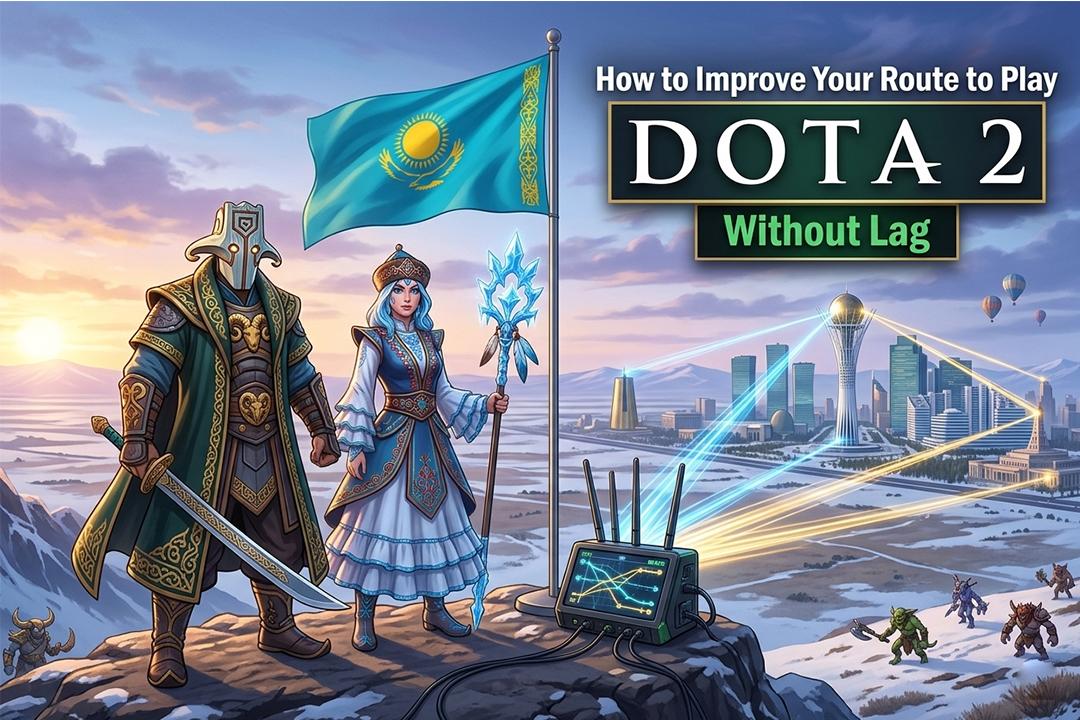
Kazakhstan's Dota 2 Culture — CIS Powerhouse
Kazakhstan has one of the strongest Dota 2 cultures in Central Asia. The game is arguably the most popular competitive title in the country, with a ranked player base concentrated in Almaty and Astana that takes matchmaking seriously.
Kazakh players are an integral part of the CIS Dota ecosystem — the region that has produced some of the most legendary teams and players in Dota 2 history. The CIS competitive scene includes Team Spirit (TI10 champions), Virtus.pro (perennial contenders), and a deep tradition of mechanically gifted players. Kazakhstan's proximity to this ecosystem — culturally, linguistically, and in ranked matchmaking — means Kazakh players compete directly against Russian, Ukrainian, and other CIS players daily.
This competitive environment breeds technically knowledgeable players. Kazakh Dota 2 players understand SDR architecture, console commands, tick rate implications, and networking fundamentals. They search for solutions in both Russian (like "серверы дота 2 казахстан" — servers dota 2 kazakhstan, or "пинг дота 2" — ping dota 2) and English. The bilingual search behavior reflects a community that consumes both Russian and English Dota 2 content.
The high-MMR concentration in Almaty is notable. Multiple semi-professional and amateur competitive teams operate from Kazakhstan, competing in CIS-region qualifiers and tournaments. For these players, the difference between stable 40ms and jittery 40-100ms is not academic — it directly affects their competitive results and ranking trajectory.
Russian Servers vs EU Servers — The Kazakhstan Dilemma
This is the core tension for every Kazakh Dota 2 player. Both server options have trade-offs:
Russian Servers — Lower Ping, Higher Risk
| Metric | Value |
| Base Ping from Almaty | 40-60ms |
| Peak Hour Jitter | 40ms → 100ms+ spikes |
| Backbone Route | Almaty → Kazakhtelecom → Moscow backbone → Russian SDR relay |
| Queue Population | Large — full CIS matchmaking pool |
| Language | Russian (comfortable for most Kazakh players) |
Russian servers provide lower base latency because Moscow SDR relays are geographically closer to Almaty (~3,400km) than Stockholm (~4,500km). The CIS matchmaking pool is large, queue times are short, and the language environment is natural for Kazakh players.
The problem is congestion and jitter. Kazakhtelecom's routing to Moscow traverses Russian backbone networks that experience evening congestion and routing instability. Base 40ms spiking to 100ms during peak hours is worse than stable higher ping for Dota 2 precision mechanics.
EU Servers — Higher Ping, More Stability
| Metric | Value |
| Base Ping from Almaty | 65-70ms |
| Jitter | Minimal — stable |
| Backbone Route | Almaty → Kazakhtelecom → Finland/Scandinavia → Stockholm SDR relay |
| Queue Population | Large — EU matchmaking pool |
| Language | Mixed (English, Russian, EU languages) |
EU servers (Stockholm relay via net_option SDRClient_ForceRelayCluster sto) provide higher base ping but significantly more stability. The routing through Finland/Scandinavia to Stockholm uses well-maintained Northern European backbone networks with less congestion variance.
The trade-off: 65-70ms is noticeably higher than 40ms for Blink Dagger precision, but stable 65ms is arguably better than jittery 40-100ms for competitive play, because consistency lets you build muscle memory.
Why Jitter Matters More Than Base Ping in Dota 2
Kazakhstan's Dota 2 problem is not high ping — 40-60ms to Russian servers is competitive. The problem is jitter: the oscillation between 40ms and 100ms+ that Kazakhtelecom's Moscow backbone routing produces. Stable 55ms versus jittery 40-100ms — which is better for Dota 2? Stable 55ms wins every time.
Blink Dagger Consistency: At jittery 40-100ms, your Blink registers at inconsistent divergence levels. The same click pattern that lands a 1200-unit Blink at 40ms triggers the 960-unit penalty at 100ms. You cannot build consistent muscle memory because the same input produces different results.
Last-Hit/Deny Reliability: At jittery ping, health bars jump. The creep you see at 50 HP might be at 10 HP on the server. CS becomes inconsistent, and you cannot practice your way to consistency because the timing changes randomly.
Spell Combo Muscle Memory: Heroes like Invoker or Tinker require rapid sequential inputs. You cannot practice combos when the network delay varies by more than 100% between attempts.
Kazakhtelecom, Beeline, Kcell — ISP Routing Analysis
| ISP | Technology | Russian Server Ping | EU Server Ping |
| Kazakhtelecom | FTTH, DSL | 40-60ms (jittery) | 65-70ms (stable) |
| Beeline KZ | FTTH, Mobile | 42-65ms (less jittery) | 63-68ms (stable) |
| Kcell | Mobile, Fixed | 50-75ms (variable) | 68-75ms (stable) |
Kazakhtelecom dominates the market but its Moscow routing suffers during evening peaks (9pm-3am ALMT). Beeline Kazakhstan often uses different backbone transit, making it an excellent bonding partner for routing diversity.
How NoPing Solves the Two-Server Dilemma — Silk Road Routing
NoPing evaluates paths to both Russian and EU servers simultaneously. Packets travel on whichever network path — Russian backbone or EU backbone — delivers fastest at any given moment.
Dynamic Path Selection: If Moscow backbone becomes congested mid-game, NoPing shifts packets to the more stable EU route automatically. Your ranked game does not suffer because backbone conditions changed after you queued.
Jitter Elimination: Multi-path routing is the direct cure for Kazakhtelecom backbone jitter. When packets travel on multiple simultaneous paths, the fastest arrival wins. A spike to 100ms on one path is invisible because packets arrived via an alternate path at 42ms.
Multi-Internet Bonding: Bond Kazakhtelecom + Beeline. During 60-minute ranked games, ISP drops are covered by the secondary connection, preventing disconnects and abandon penalties.
| Route | Default | NoPing Optimized |
| Almaty → Russian SDR | 40-60ms (spikes to 100ms) | 35-50ms stable |
| Almaty → EU SDR (Stockholm) | 65-70ms stable | 50-60ms stable |
| Almaty → Dynamic (Best) | Varies | 35-55ms stable |
Download NoPing — Silk Road Routing for Kazakhstan Dota 2
The Dubai Context — Minimal Impact for Kazakhstan
The Dubai SDR relay disruption in March 2026 has negligible impact on Kazakhstan. Dubai was always a tertiary option at 80-110ms from Almaty. Kazakh players prefer Russian or EU servers. NoPing eliminates the need to manually choose by automatically using whichever path is fastest.
NoPing vs VPN vs ExitLag for Dota 2 Kazakhstan
| Feature | NoPing | ExitLag | VPN |
| RU + EU Optimization | Yes | No | No |
| Multi-path routing | Yes | No | No |
| ISP bonding | Yes | No | No |
| Encryption overhead | None | Minimal | 5-15ms |
FAQ — Dota 2 Kazakhstan 2026
Q: What is the best server for Dota 2 in Kazakhstan?
A: Russian servers have lower base ping but more jitter. EU/Stockholm is more stable. NoPing optimizes both: Russian 35-50ms stable, EU 50-60ms stable.
Q: How does NoPing fix Kazakhtelecom jitter?
A: Multi-path routing sends packets on multiple paths. If the primary route spikes, packets arrive via an alternate path, smoothing jitter from 40-100ms to stable 35-50ms.
Q: Can I bond Kazakhtelecom and Beeline?
A: Yes. Multi-Internet bonding combines both ISPs to protect against drops and provide better routing diversity.
Conclusion
Kazakhstan's Dota 2 community no longer needs to choose between Russian jitter and EU stability. NoPing evaluates both network paths simultaneously, ensuring your packets take the optimal "Silk Road" at every moment. Jitter elimination and ISP bonding transform an inconsistent 40-100ms connection into a professional-grade 35-50ms stable experience.
Try NoPing Free Trial — Let the Silk Road Choose Your Route