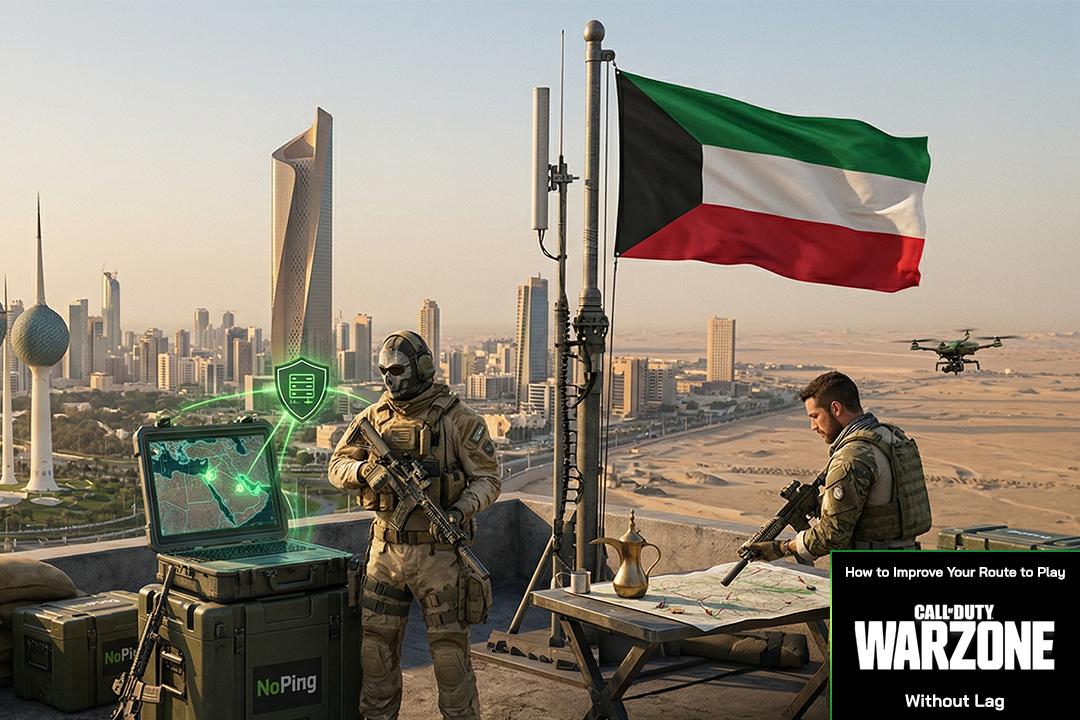
Kuwait's CoD Players Are Fighting Two Enemies — Lag and Power Outages
Final circle in Al Mazrah. Five players left. You have survived 22 minutes, found your loadout, plated up, rotated into a strong position. Your ping reads 130ms — already a handicap that puts you behind every gunfight. You spot an enemy breaking cover, slide cancel to a headglitch, line up the shot through your scope. The crosshair is on their head. You pull the trigger.
Your screen freezes for half a second. Power brownout. When connectivity returns, you are staring at the gulag — if you are lucky. More likely, you are back at the lobby screen. Twenty-two minutes of looting, fighting, surviving, and rotating, erased by a combination of server lag and a power micro-interruption that lasted less time than a slide cancel animation.
This is the Kuwait CoD experience in March 2026. A dual crisis that no other Gulf country faces in quite the same way.
Problem one: Bahrain server infrastructure degraded from 20-40ms to 110-140ms, with CoD's matchmaking algorithm auto-redirecting Kuwaiti players to Eastern Europe lobbies where they compete against opponents at 20-30ms.
Problem two: Power infrastructure issues causing micro-brownouts and brief interruptions that can disconnect Warzone sessions lasting 25-30 minutes. A momentary power fluctuation that you might not even notice on your lights is enough to drop a game connection.
Both problems hit simultaneously. One makes every gunfight and gulag unfair. The other makes every long match a gamble. Together, they make competitive Call of Duty in Kuwait nearly unplayable without protection.
This survival guide covers both threats and the single solution that addresses them in tandem. NoPing's multi-path routing fixes the ping problem. NoPing's multi-internet bonding fixes the disconnect problem. Both features work with RICOCHET Anti-Cheat without any risk.
Both Warzone with its 20-40Hz tick rate across 150-player lobbies and MWIII Multiplayer at 60Hz in smaller competitive formats are affected. Here is how to keep playing through both problems.
NoPing download page — noping.com
What Happened to Call of Duty's Middle East Servers
The server side of Kuwait's dual crisis follows the same pattern affecting the entire Gulf region.
Activision's Call of Duty multiplayer runs through Demonware, their proprietary networking infrastructure, built on Amazon Web Services. The regional backbone for Middle East players was AWS ME-SOUTH-1 in Bahrain. This facility delivered the 20-40ms ping that Kuwaiti players enjoyed for years.
In March 2026, conflict-driven infrastructure damage across the Middle East degraded operations at the Bahrain data center. Submarine cable systems crossing the Red Sea — carrying over 95% of data traffic between Europe, Asia, and the Middle East — suffered physical damage. AWS characterized recovery as "prolonged," a word they rarely use. Cable repair ships could not operate in the affected zones. Water damage compounded the physical destruction.
For Kuwait, the chain reaction is straightforward: Bahrain connection degrades from 20-40ms to 110-140ms. Demonware's matchmaking algorithm detects the elevated ping. The system determines Kuwait players' connection quality is insufficient for Middle East lobbies. Auto-redirect to Eastern Europe. Kuwaiti players now face EU opponents at 20-30ms while struggling at 110-140ms.
Warzone vs. MWIII — Both Broken, Different Tick Rates
Warzone operates at 20-40Hz tick rate across 150-player lobbies. The server updates player positions every 25-50 milliseconds. At 110ms ping, you are 2-5 full server ticks behind reality. Every enemy position on your screen is where they were several ticks ago.
MWIII Multiplayer runs at 60Hz, updating every 16.7 milliseconds. At 110ms, you are 6-7 ticks behind. In CoD's 200-350ms Time-to-Kill environment, being that far behind means the fight is functionally decided before your client renders the enemy's first shot.
Both modes feel fundamentally wrong. Warzone is sluggish. Multiplayer gunfights feel predetermined. The matchmaking redirect to EU compounds everything.
Why Kuwait Has It Worse — Power Brownouts Meet Server Lag
Other GCC countries face the ping problem. Kuwait uniquely faces both the ping crisis and power infrastructure issues that create a second threat vector for competitive gaming.
Kuwait experiences power infrastructure issues that cause brief brownouts and micro-interruptions — momentary dips that might flicker a light or briefly cycle a router. In everyday life, these are minor inconveniences. For a Warzone player 22 minutes into a 150-player match, they are catastrophic.
A Warzone match represents a serious time investment. Dropping in, looting, surviving early fights, managing the gas rotation, collecting loadout drops, plating up for the final circles — all of that can stretch to 25-30 minutes. Kuwait players face two distinct ways to lose that investment:
The lag threat: At 110-140ms ping with matchmaking redirecting to EU servers, every gunfight and every gulag is played at a reaction time disadvantage. You lose fights that your aim and positioning should win because the server processes your opponent's actions first.
The disconnect threat: A power brownout lasting 200 milliseconds — imperceptible in most contexts — can be enough to drop your internet connection momentarily. Your router cycles, your connection resets, and by the time it recovers, Call of Duty has disconnected your session. Back to the menu. Twenty-five minutes gone.
In MWIII Multiplayer, a disconnect mid-match loses your match progress and can affect your rank standing. In Warzone Ranked, a disconnect counts as an abandonment.
This dual vulnerability means Kuwait's CoD players need a dual solution — something that addresses both the routing inefficiency and the connection fragility simultaneously. Multi-internet bonding is not a luxury feature for Kuwait. It is essential equipment.
What 110ms Ping Actually Does to Your CoD Matches
Setting aside the disconnect risk for a moment, here is what the lag itself does to specific Call of Duty mechanics across both titles.
The Gulag Is a Lag Test, Not a Skill Test
The gulag puts two players in equal conditions — identical loadouts, equal health, symmetric arena. The only variable should be player skill. But when one player connects at 20ms from Europe and the other at 110ms from Kuwait, the conditions are anything but equal.
The low-ping player sees you first on the server. Their trigger pull registers first. Their bullets connect first. On your screen, you might fire simultaneously. In the killcam, they had the advantage from the start.
Kuwait players report gulag win rates dropping from healthy 55% down to below 35% after the server migration. Every lost gulag after a laggy death or — even worse — after a brownout-caused death, compounds the frustration. The comeback mechanic designed to keep you in the game becomes yet another reminder that your connection is the opponent you cannot outplay.
TTK Is So Fast You Die Before Reacting
CoD's 200-350ms Time-to-Kill at 110ms ping means 30-50% of your reaction window is consumed by latency. In MWIII Multiplayer, the enemy has fired 2-3 bullets before you see the first hitmarker on your screen. Their damage is dealt before your client renders the threat.
In Warzone, armor plates feel like they provide no protection. You pop a plate, hear the insertion sound, see your armor meter fill — but the server has not registered the armor yet. Incoming fire passes through what your screen says is active protection. You die "through" your plates, and the killcam confirms the server never recognized the armor application.
Movement and Warzone Mechanics Break
The competitive movement meta — slide canceling, bunny hopping, dropshotting — relies on server-client position synchronization. At 110ms, the server sees you in a fundamentally different position than your screen shows. Movement techniques designed to make you harder to hit become unreliable when your server-side model does not match your client-side animation.
Warzone-specific mechanics compound the problem. Plate insertion does not register in time. Buy station interactions have dangerous server handshake delays. Loadout drop collection leaves you exposed for an extra 110ms. Gas and zone position is server-authoritative, meaning you take damage before your screen shows you inside the zone boundary. Killstreak activations — UAVs, cluster strikes, precision airstrikes — have delayed confirmations that cost kills in fast-paced endgame scenarios.
"Switch to Zain" / "Get a UPS" — Partial Solutions at Best
The first advice Kuwait CoD players receive is to change ISPs or buy a UPS. Neither addresses the full problem.
Switching between Zain Kuwait (roughly 40% market share), Ooredoo Kuwait (approximately 35%), or STC Kuwait (about 25%) does not fix the routing issue. All three ISPs route international gaming traffic through similar backbone paths. The infrastructure degradation affects the shared international links, not the individual ISP's local network. Swapping ISPs might change your experience by a few milliseconds, but it will not turn 110ms into 40ms.
A UPS (Uninterruptible Power Supply) handles full power outages by providing battery backup. But power brownouts — the brief voltage dips that cycle a router — can still disrupt your connection because the router and ONT (optical network terminal) may reset during even momentary fluctuations that a basic UPS might not fully buffer. And even a perfect UPS setup does nothing for the 110ms ping problem.
VPNs add latency by routing through an additional server hop, increasing ping by 10-30ms. Some players also have concerns about VPNs and RICOCHET Anti-Cheat — while those concerns are technically unfounded (VPNs do not trigger RICOCHET), using a VPN still makes your already-bad ping worse.
What Kuwait players need is both routing optimization and connection redundancy simultaneously. The only complete solution combines multi-path routing to reduce ping with multi-internet bonding to prevent disconnects. Fixing one problem while ignoring the other still leaves you vulnerable.
How NoPing Solves Both of Kuwait's CoD Problems
NoPing is the only tool that addresses Kuwait's unique dual crisis — the ping problem and the disconnect problem — in a single solution.
Multi-Path Routing — The Diwaniya Network
In Kuwait, diwaniyas are a way of life. Regular social gatherings across different homes and neighborhoods, where the community stays connected through multiple points of contact. If your regular diwaniya is full or unavailable on a given evening, you visit another without missing a beat. The social network has built-in redundancy.
NoPing applies this same principle to your game traffic routing. Instead of sending your packets along a single path to Demonware's servers, NoPing establishes multiple simultaneous routes. Each path travels through different infrastructure — different submarine cables, different international peering points, different backbone nodes.
NoPing measures latency on every active path in real-time. If one path is congested during peak evening hours (8 PM to 1 AM is prime gaming time in Kuwait), your packets are already traveling on an alternative path. There is no delay in switching because all paths carry traffic simultaneously — NoPing uses whichever packet arrives at the destination first.
The result is consistent, optimized latency to Demonware servers. Where your ISP sends every packet along one potentially congested path, NoPing distributes across multiple paths and selects the best outcome every time.
Multi-Internet Bonding — Your Connection's Safety Net
This is NoPing's critical feature for Kuwait specifically. Multi-internet bonding combines two ISP connections — for example, Zain fiber plus Ooredoo mobile, or any available combination — into one unified, resilient connection for game traffic.
If one ISP connection drops due to a power brownout affecting that particular line, the other ISP maintains your game session seamlessly. Your Warzone match does not disconnect. The transition happens at the network level, invisible to you and to the game server. One moment your packets travel on two paths. The next moment, one path drops and traffic flows entirely through the surviving path. No interruption. No rubber-banding. No lobby screen.
This addresses Kuwait's unique dual problem in a way that no other solution can. A UPS protects against full outages but not brownout-induced router cycles. Switching ISPs changes which single point of failure you depend on. NoPing's bonding eliminates the single point of failure entirely.
For a 150-player Warzone match lasting 25-30 minutes, bonded multi-internet is insurance against the disconnect that has cost Kuwait players countless hard-earned victories.
Route Optimization — Keep on ME Servers
NoPing's optimized routing can reduce your Bahrain ping below the matchmaking threshold that triggers the EU redirect. If Demonware's algorithm sees an acceptable connection to ME-SOUTH-1, you stay in Middle East lobbies where the ping differential between players is smaller and the playing field is more level.
Even on EU servers, NoPing shaves 20-35ms off through intelligent path selection. Moving from 110ms to 80ms in a gulag means the reaction time gap narrows from decisive to manageable. At 80ms, CoD's netcode compensation systems can smooth out the remaining latency more effectively.
Packet loss — a separate but equally damaging issue — is virtually eliminated through multi-path redundancy. Every bullet you land on your screen registers on the server. In CoD's fast TTK, consistent hit registration transforms gunfight outcomes.
RICOCHET Anti-Cheat — Fully Safe
NoPing is a network optimizer, not a game modifier. It operates at the routing level — optimizing how your internet traffic travels between your PC and the game server.
NoPing does not inject code into Call of Duty. It does not modify game files. It does not hook into game processes. It does not use kernel drivers that conflict with RICOCHET. The anti-cheat system monitors game memory and process integrity. NoPing touches neither.
Thousands of CoD players across Warzone and MWIII use NoPing daily worldwide without any ban issues. It is fundamentally transparent: your game traffic takes a faster route, nothing more.
Realistic expectations for Kuwait players:
| Metric | Without NoPing | With NoPing |
| Ping | 110-140ms | 80-105ms |
| Disconnect risk (brownouts) | High during long matches | Eliminated via ISP bonding |
| Packet loss | Variable, inconsistent | Near-zero |
| ME server retention | Auto-redirected to EU | Potential to stay on ME |
| Gulag competitiveness | Severely disadvantaged | Competitive |
How to Set Up NoPing for Call of Duty in Kuwait
Setup takes minutes and protects both your ping and your connection:
- Download NoPing from noping.com.
- Create your account or log in.
- Select your game: "Call of Duty: Warzone" or "Call of Duty: Modern Warfare III."
- NoPing auto-detects the optimal route to Demonware's servers, testing multiple paths.
- Click "Optimize." NoPing selects the fastest routing combination.
- Launch Call of Duty normally through Battle.net or Steam.
- Check ping via in-game telemetry (Settings > Account > Network in Warzone).
Kuwait-specific tip: Connect BOTH ISP connections (for example, Zain fiber plus Ooredoo mobile backup) before launching NoPing. The bonding feature is your insurance policy against brownout disconnects. Do not skip this step — it is the feature that makes Kuwait's dual problem manageable.
Warzone session tip: For long gaming sessions, NoPing's bonding is especially critical. A single disconnect in the final circle of a 25-minute match is devastating. With dual ISPs bonded, your connection survives momentary power hiccups that would otherwise send you back to the lobby.
Ranked Play tip: NoPing's routing optimization and disconnect protection work in all competitive modes. Warzone Ranked and MWIII Ranked Play both benefit from lower ping and elimination of disconnects that count as abandonment penalties.
Frequently Asked Questions — Call of Duty Ping in Kuwait
Q: Is NoPing safe with RICOCHET Anti-Cheat?
A: Yes. NoPing optimizes network routes — it does not interact with the Call of Duty game client or RICOCHET's kernel driver in any way. It is the equivalent of choosing a faster highway to your destination. The game itself is untouched. Thousands of CoD players use NoPing daily with zero ban issues across all modes.
Q: Can NoPing really protect me from power brownout disconnects?
A: Yes. Multi-internet bonding means NoPing maintains your game session across two ISP connections simultaneously. If one ISP drops due to a brownout — a momentary power fluctuation that cycles your router or ONT — the other ISP path maintains the connection without interruption. Your Warzone match stays alive through power hiccups that would otherwise disconnect you.
Q: Why am I being redirected to EU lobbies?
A: CoD's Demonware matchmaking has an internal ping threshold. When your connection to Bahrain servers exceeds that threshold (approximately 100ms), the algorithm automatically sends you to Eastern Europe lobbies. NoPing's routing optimization can reduce your Bahrain ping below that threshold, potentially keeping you in Middle East lobbies.
Q: Does this work for BOTH Warzone and MWIII Multiplayer?
A: Yes. Both titles share Demonware's network infrastructure on the same AWS backbone. NoPing optimizes the route to these servers regardless of which CoD game or mode you play. Battle royale, Resurgence, 6v6 Multiplayer, Ranked Play — all benefit.
Q: Does NoPing work with Zain, Ooredoo, and STC Kuwait?
A: All three Kuwaiti ISPs are fully supported. For the best experience — especially given Kuwait's dual problem — bond two ISPs together. The different routing paths between ISPs maximize your path diversity and provide failover protection.
Q: Will Activision fix the Middle East server situation?
A: No timeline has been announced. The Bahrain infrastructure needs physical repair to submarine cables and data center facilities. NoPing is the solution available now while that restoration process unfolds.
Q: Can I use NoPing for Warzone Ranked and MWIII Ranked Play?
A: Yes. NoPing is allowed in all competitive modes because it does not modify the game client or interact with anti-cheat systems. It optimizes your network connection, which is a legitimate and permitted form of optimization. Many competitive players use network optimizers as standard practice.
Q: My gulag win rate has tanked. Will NoPing fix this?
A: By reducing ping from 110ms or more down to 80-105ms, NoPing significantly narrows the reaction time gap in gulag encounters. At 80ms, the disadvantage against EU players at 20ms is still present but manageable — CoD's netcode compensation handles it better, and gunplay skill returns as the primary factor. Players consistently report improved gulag performance after optimizing their connection.
Kuwait's CoD Players Need a Dual Solution — NoPing Delivers Both
Kuwait's unique position in the March 2026 CoD crisis demands a unique response. Other Gulf countries face the ping problem alone. Kuwait faces ping degradation and connection fragility simultaneously — two threats that compound each other and make every Warzone match a gamble.
NoPing is the only tool that addresses both threats in a single solution. Multi-path routing optimizes your connection to Demonware servers, reducing ping from uncompetitive 110-140ms to manageable 80-105ms and potentially keeping you on Middle East servers instead of the EU redirect. Multi-internet bonding protects your connection by maintaining game sessions across two ISP paths, eliminating the disconnect risk from power brownouts.
The gulag should be won by aim, not by latency advantage. The final circle should be won by strategy, not by which player's power grid held up. MWIII ranked progression should reflect skill, not connection stability. NoPing puts all of those outcomes back in your hands.
Think of it as essential equipment for Kuwait CoD players in 2026 — as important as your headset, your controller, or your gaming monitor.
Try NoPing free for Call of Duty — protect your Warzone matches at
noping.com.