

It is finally happening. After what felt like an eternity of rumors and community wishlists, the Paladin has returned to Sanctuary.
If you have pre-ordered the Lord of Hatred expansion, you are probably already throwing shields and praising the Light in Season 11. But if you are just jumping in or trying to figure out how to optimize this holy warrior, you are in the right place.
The Paladin in Diablo IV is not just a copy-paste from Diablo II. It is a tanky, support-heavy, damage-dealing powerhouse that brings a lot of new mechanics to the table.
Let’s dive deep into everything you need to know to crush demons with divine prejudice.

What is the Paladin’s Unique Class Mechanic?
The Paladin’s unique mechanic is the Oath System.
This system allows you to specialize your Paladin into one of four distinct archetypes at Level 15, drastically changing how you play.
Unlike the Sorcerer's Enchantments or the Druid's Spirit Boons which offer passive bonuses, the Oath System fundamentally alters your resource management and playstyle identity.
When you unlock your Oath, you commit to a specific path. Here is the breakdown of the four Oaths available in Patch 2.5.0:
- Zealot: This is for the players who want to attack fast and furiously. The Zealot Oath focuses on the Fervor mechanic. As you land hits with Zealotry skills, you build Fervor stacks that increase your attack speed and multi-hit chance. It is perfect for those "blender" melee builds.
- Juggernaut: If you want to be the unkillable object, this is your pick. The Juggernaut Oath scales your damage based on your Armor and Block Chance. It turns your shield into your primary weapon and defense mechanism, making you incredibly tanky while still dishing out pain.
- Judicator: This is the caster-hybrid archetype. Judicators mark enemies and detonate them with Holy damage. It focuses on Area of Effect (AoE) clear and supports the party by making enemies vulnerable to massive burst damage.
- Disciple: The most unique of the bunch. This Oath allows you to ascend into an angelic form called the Arbiter. When you use specific cooldowns, you transform, gaining new movement capabilities and massive buffs to your damage and survivability for a short duration.
What Resource Does the Paladin Use?
The Paladin uses Faith.
Faith is a dual-state resource that behaves differently depending on your Oath and skills, but generally, it regenerates slowly over time and is generated actively through your Basic Skills like Advance and Brandish.
Managing Faith is key to the Paladin’s rhythm. Unlike the Barbarian’s Fury which drains or the Rogue’s Energy which refills quickly, Faith is stable but heavy. You need to weave in your generators to keep your Auras active and your big spenders online.
Some builds, specifically the Zealot, have ways to bypass Faith costs by using Health or Fervor stacks, while the Juggernaut often gains Faith by Blocking attacks.
Mastering your Faith generation rotation is the difference between a Paladin that stands around and one that clears T100 Pits with ease.
Also read: Jitter vs Latency/Ping: What's The Difference and How to Deal With Them
What Are the Best Paladin Skills?
The best skills currently revolve around Zeal, Falling Star, and the class-defining Auras.
While "best" is subjective to your build, these skills are the cornerstones of the current Season 11 meta because of their versatility and raw power scaling.
Deep Dive:
Here are the standout skills you should look at:
- Zeal (Core): A rapid series of strikes that hits multiple enemies. When paired with the Zealot Oath, this becomes a machine-gun of holy damage. It is the bread and butter for melee builds.
- Falling Star (Ultimate/Mastery): You leap into the air and crash down, dealing massive Holy damage. It is both a gap closer and a nuke. The visual is incredible, but the damage numbers are even better.
- Brandish (Basic): You unleash an arc of light. It is fantastic for clearing trash mobs and generating Faith from a safe distance before you commit to the fight.
- Holy Light Aura (Passive/Active): Auras are back and they are huge. Passive Auras affect you and your party constantly. Holy Light Aura burns enemies near you and can be activated to unleash a burst of damage and Fortify you.
- Shield Charge (Brawl): Essential for mobility. You rush forward, pushing enemies and pinning them against walls. In Diablo IV’s physics engine, this feels heavy and satisfying.
What Are the Top Paladin Builds for Season 11?
The top builds right now are the Arbiter Disciple, the Zealot, and the Brandish Caster.
The meta is still settling since the Lord of Hatred pre-release dropped, but these three have emerged as the clear winners for Endgame content, especially for pushing the new difficulty tiers.
- Arbiter Disciple (The "Winged" Build):
This build uses the Disciple Oath. The goal is to maximize your uptime in the Arbiter form. You use cooldown reduction gear to spam skills that trigger the transformation. Once you are in Arbiter form, you use Wing Strikes to passively deal damage just by moving through enemies. It is a fast, smooth playstyle that feels like you are dancing through the dungeon.- Key Stats: Cooldown Reduction, +Rank to Transformation Skills, Critical Strike Chance.
- Zealot Paladin (The "Blender"):
Classic Diablo II vibes. You pick the Zealot Oath and stack Attack Speed. The idea is to hit the Fervor cap instantly and sustain it. You will use Zeal as your main damage source and Fanaticism Aura to boost your speed even further. It shreds bosses in seconds.- Key Stats: Attack Speed, Basic Skill Damage, Life on Hit.
- Brandish Caster (The "Ranged" Paladin):
If you prefer to stay back, this build uses the Judicator Oath and the Brandish skill. You turn your basic attack into a screen-clearing wave of light. By using the Supplication upgrade, your Brandish waves boomerang back, hitting enemies twice. It is arguably the best speed-farming build right now.- Key Stats: Holy Damage, Resource Generation, Lucky Hit Chance.

What Unique Items Are Essential for Paladins?
You need to hunt for Herald of Zakarum and Griswold’s Opus.
These two Unique items are currently defining the class drop tables. While you can play without them, obtaining them will skyrocket your power level.
Deep Dive:
- Herald of Zakarum (Unique Shield): This is best-in-slot for almost every Paladin build. It provides massive Block Chance and converts a percentage of your Block Chance into Critical Strike Damage. If you are playing a Juggernaut, this shield is mandatory.
- Griswold’s Opus (Unique Sword): A callback to the Tristram blacksmith. This sword adds flat Holy damage to your attacks and increases the range of your Auras. It is fantastic for group play and Zealot builds.
- Sanctis of Kethamar (Unique Amulet): This is the chase item for the Arbiter Disciple build. It grants a chance for your Arbiter form attacks to deal double damage.
Can Paladins Play Solo?
Absolutely, Paladins are one of the best solo classes in the game right now.
Their natural tankiness combined with self-healing makes them very forgiving. You do not need a glass-cannon approach because your survivability is baked into your kit.
The Paladin shines in solo play because of the Mercenary system synergy. If you pair a Paladin with Raheir (the Shieldbearer mercenary), you become an impenetrable wall.
You can taunt enemies off your Mercenary or have him tank for you while you cast from a distance. The class is designed to be self-sufficient.
You have Auras for damage, passives for healing, and high armor values. You will rarely find yourself one-shot by mechanics that would delete a Sorcerer or Rogue.
Also read: Path of Exile 2 vs Diablo 4: Which One is For You?
Why Is NoPing Essential for Paladin Players?
Paladin builds, especially the Zealot and Arbiter, rely heavily on precise timing and rapid inputs.
When you are pushing high Zeal stacks, you are attacking multiple times per second. A lag spike here doesn't just mean a missed attack; it means dropping your Fervor stacks and losing your entire damage ramp-up.
NoPing is a service designed to optimize your route to Diablo IV’s servers. Sometimes, the normal path your internet provider uses isn’t the fastest. NoPing reroutes your data through a better, more direct path.
Here’s how to use NoPing to fix network issues in Diablo IV:
- Sign-up through the website and download NoPing (you can try it for free)
- Open NoPing and search for Diablo IV inside the software

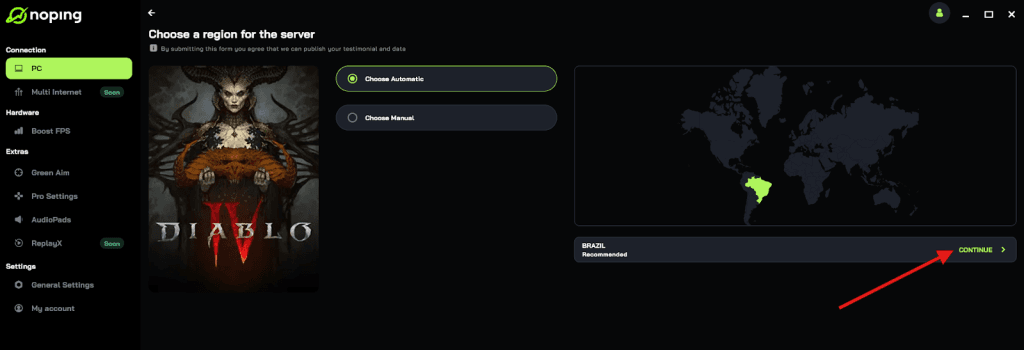
- Once you find Diablo IV, click on it and, on the next screen, select “Choose automatic” or “Choose manual” and click “Continue”. We recommend choosing automatic, as NoPing’s technology analyzes all routes on a global scale and automatically selects the best option for you.
- On the next screen, click on “Optimize Game”.
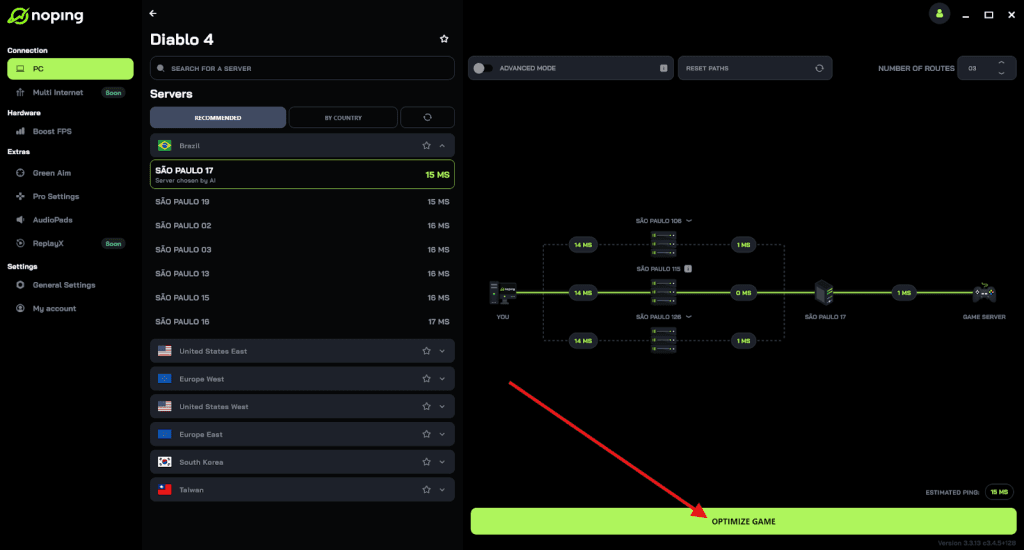
- And that’s it, you can start playing Diablo IV with optimized ping!
You can test different servers within NoPing to see which gives you the lowest latency.