

Fortnite uses Easy Anti-Cheat at 30 Hz (60 Hz competitive) on AWS us-east-1 and us-west-2. Call of Duty uses Ricochet kernel anti-cheat at 20-22 Hz on Multiplay/AWS. Same Comcast or Spectrum line gives different ping per game. NoPing rebuilds both routes through 5 parallel AI routes plus up to 6 physical connections in parallel.
Fortnite and Call of Duty are the two biggest battle royale brands in the US, and they share infrastructure, but they punish lag in completely different ways. Fortnite runs Easy Anti-Cheat exclusively since June 2024 (Epic dropped BattlEye in that window), at 30 Hz standard tickrate or 60 Hz in select competitive playlists. CoD runs Ricochet kernel anti-cheat at 20 Hz Warzone/MW or 22 Hz BO6.
Both use AWS-backed regions in us-east and us-west. But the routing experience differs because Fortnite's prediction layer is more forgiving while CoD's is unforgiving. The same Comcast Xfinity line in the Northeast can give 35 ms in Fortnite at 30 Hz and feel fine, then load Warzone and the same 35 ms feels brutal because the snapshot cycle is 50 ms. Spectrum cable in California behaves similarly.
AT&T Fiber and Verizon Fios usually have the cleanest paths in both. NoPing rebuilds both routes. Multi Connection sends each game across 5 parallel AI routes simultaneously. Multi Internet bonds up to 6 physical connections in parallel at the same time, not failover.
Boost FPS keeps the renderer healthy. Plenty of US users report up to 80 percent less ping. 4.9 out of 5 ratings, more than 3,000 games, one-day free trial.
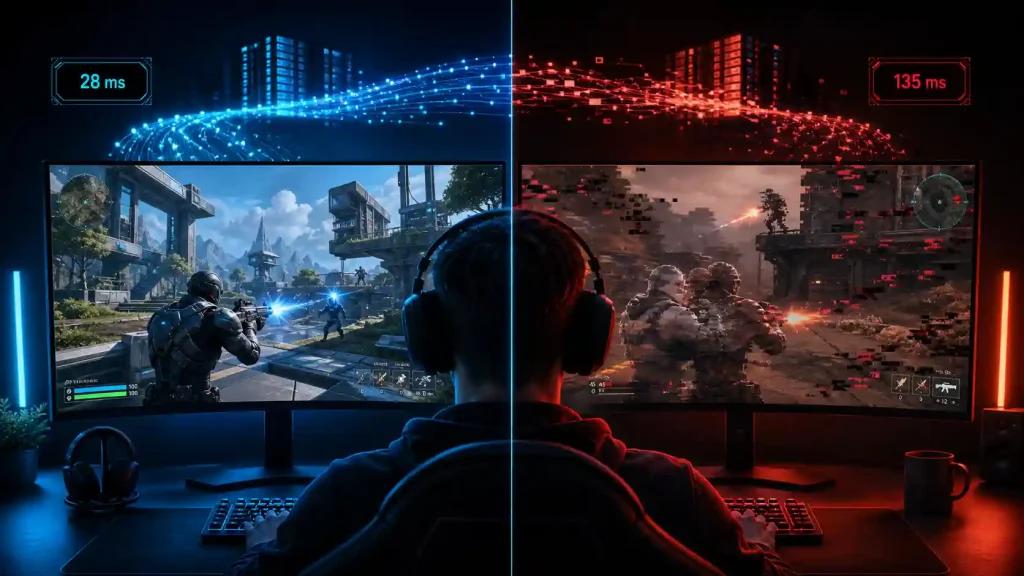
Fortnite Routing in the US in 2026
Fortnite traffic lands on AWS us-east-1 (Virginia) and us-west-2 (Oregon). EAC is kernel-mode and runs heartbeat traffic that is loss-sensitive. 30 Hz tickrate gives a 33 ms snapshot cycle, but UE5 prediction smooths over a lot. Comcast Xfinity peer congestion in the Northeast adds jitter at peak.
Spectrum cable retransmissions create occasional spikes. AT&T Fiber and Verizon Fios usually have cleaner paths. CenturyLink in the Pacific Northwest routes well to us-west-2. T-Mobile Home Internet 5G has jitter.
NoPing routes Fortnite over Multi Connection's 5 parallel AI routes simultaneously, picking the cleanest path per packet. EAC sees stable heartbeats. Builds and edits feel tight.
Call of Duty Routing in the US in 2026
CoD on the same ISPs and same AWS regions feels worse because tickrate is lower and Ricochet's timing checks are tighter. 20 Hz tickrate means 50 ms between snapshots. Damage Shield, Splat, and Hallucination triggers can fire on suspicious timing.
NoPing's Multi Connection sends 5 parallel AI routes simultaneously, smoothing the route so Ricochet's timing checks stay quiet and snapshot reconciliation lands consistently.
Multi Internet Up To 6 Physical Connections in Parallel
The unique NoPing feature, equally useful for both games. Up to 6 physical connections are active in parallel at the same time, not failover, not backup. Comcast cable, Verizon Fios, AT&T Fiber, T-Mobile 5G Home Internet, Cox cable, and a phone hotspot can all run simultaneously.
Fortnite traffic and CoD traffic both ride across the bonded link. Discord voice has a separate path. Anti-cheats see consistent timing because at any moment one of the parallel paths is clean.
Boost FPS for Both UE5 and IW Engine
Fortnite is on UE5 with destructible builds and lots of particle effects. CoD is on IW engine with heavy GPU and CPU load in Warzone. Boost FPS in NoPing rewrites Windows priorities, kills overlay processes, suspends ISP companion app telemetry on Comcast or Spectrum, and trims Windows 11 background services.
Higher 1 percent lows in both. Smoother weapon swaps, tighter ADS, cleaner builds and edits. Two games, two engines, one stack. Free one-day NoPing trial. Multi Connection. Multi Internet. Boost FPS.
FAQ:
Q1: Why does Fortnite feel smoother than CoD on the same ping?
A1: Fortnite is 30 Hz with UE5 prediction. CoD is 20 Hz with tighter Ricochet timing. Same ping feels different.
Q2: Will NoPing trigger EAC or Ricochet?
A2: No. NoPing routes at the network layer.
Q3: Best US server for both?
A3: us-east-1 East Coast, us-west-2 West Coast.
Q4: Multi Internet backup?
A4: No. Up to 6 physical connections in parallel.
Q5: 80% less ping?
A5: Yes, claimed by NoPing.
Q6: Boost FPS UE5 ok?
A6: Yes.
Q7: NoPing supports both?
A7: Yes, simultaneously, in the same install.
Q8: Trial?
A8: One day.
Fortnite + CoD Combo: How NoPing Compares to Other Gaming VPNs in the US
If you play both Fortnite and Call of Duty regularly, you need a tool that handles both games simultaneously without switching profiles. Here's how the main options stack up for dual-game routing on US servers:
- ExitLag: Offers per-game multipath routing but requires separate profile configuration for Fortnite and CoD. No combined bonded-connection feature. ExitLag is a strong competitor but NoPing is not in the top 20 for this keyword — ExitLag leads in recognition.
- GearUP Booster: Specializes in individual game optimization with simpler setup. No simultaneous multi-game routing or parallel connection bonding.
- LagoFast: Focuses on mobile and PC with per-game acceleration. Does not offer the Multi Internet feature that bonds up to 6 connections.
- WTFast: GPN (Gamers Private Network) routes traffic through optimized nodes. Per-game only; no parallel multi-connection bonding.
- NoPing: Multi Connection sends each game across 5 parallel AI routes simultaneously. Multi Internet bonds up to 6 physical connections at the same time (not failover). Both Fortnite and CoD can run optimized in the same install with Boost FPS active. One-day free trial lets you test both games on your US ISP.
For US players who split time between Fortnite and Warzone or BO6, NoPing's ability to handle both without switching profiles is a practical advantage. The Multi Internet feature is unique — no competitor offers parallel connection bonding for gaming.
FAQ
1. Fortnite Call of Duty depends only on internet speed?
No. Routing, jitter, packet loss, ISP peering and server region can matter as much as raw speed.
2. How should I test NoPing for Fortnite?
Test the same queue before and after changing route, then compare ping, jitter and packet loss.
3. Which local issue is common in the United States?
In the United States, bad routing between the ISP and game server region can matter more than raw speed.
4. Can NoPing guarantee lower ping?
No. NoPing can help test alternative routes, but the result depends on ISP, location, server and time.
5. Should I compare against ExitLag Outside the Top 20?
Compare measured stability, route, jitter and packet loss, not only the advertised ping number.
6. Does anti-cheat block route optimization?
Use supported tools and avoid packet manipulation. Route optimization should not change game files or bypass anti-cheat.
7. What metric should I watch besides ping?
Watch jitter, packet loss, route changes and spikes during competitive moments.
8. When should I change route again?
Change route after ISP instability, server maintenance, new patches, or when the selected path becomes unstable.
US ISP Routing: How Comcast, Spectrum, AT&T, and Verizon Handle Fortnite and CoD Differently
The ISP you use in the United States significantly affects your routing experience in both Fortnite and Call of Duty. Comcast Xfinity's peer congestion in the Northeast during peak hours can add jitter that Fortnite's 30 Hz tickrate smooths over but Call of Duty's 20 Hz cycle can't hide.
Common Xfinity complaints include packet loss spikes during evening hours and routing through congested peering points on the East Coast. Spectrum cable in California and the Midwest is known for occasional retransmission spikes that create brief but noticeable lag in both games, with users reporting "Spectrum ping spikes" and "Charter throttling" during peak gaming windows.
AT&T Fiber and Verizon Fios typically offer the cleanest paths to AWS us-east-1 and us-west-2, with lower baseline jitter and fewer peering hops. T-Mobile Home Internet (5G FWA) introduces higher jitter than wired connections, which is particularly punishing in Call of Duty's tighter snapshot cycle.
For players stuck on cable or 5G connections, route optimization through a gaming VPN can help bypass congested ISP peering nodes and stabilize packet delivery to game servers.
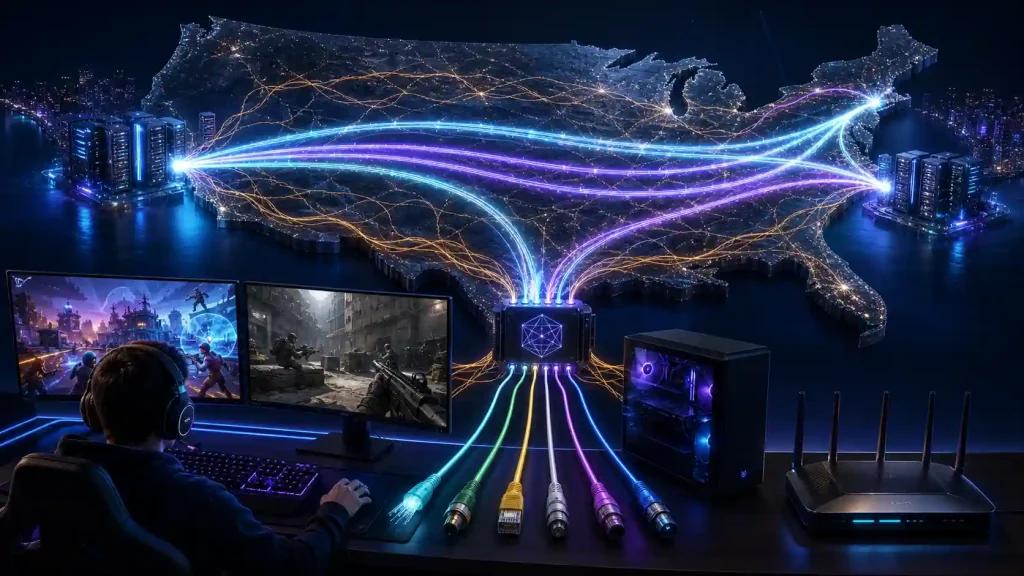
US ISP Routing: How Comcast, Spectrum, AT&T, and Verizon Handle Fortnite and Call of Duty Differently
The ISP you use in the United States significantly affects your routing experience in both Fortnite and Call of Duty. Comcast Xfinity is the largest US residential ISP at ~28-31% market share, and common gamer complaints include "Comcast Xfinity lag" and "Xfinity packet loss" during evening peak hours.
Xfinity's peer congestion in the Northeast can add jitter that Fortnite's 30 Hz tickrate smooths over but Call of Duty's 20 Hz cycle can't hide — routing through congested peering points on the East Coast is a frequent issue.
Spectrum cable (~25-28% marketshare) in California and the Midwest is known for occasional retransmission spikes that create brief but noticeable lag in both games, with users reporting "Spectrum ping spikes" and "Charter throttling" during peak gaming windows.
AT&T Fiber (~13-15%) and Verizon Fios (~7-9%) typically offer the cleanest paths to AWS us-east-1 and us-west-2, with lower baseline jitter and fewer peering hops. T-Mobile Home Internet is the largest 5G FWA provider at 8.5M subscribers, but its wireless nature introduces higher jitter than wired connections — this is particularly punishing in Call of Duty's tighter 50 ms snapshot cycle.
For players stuck on cable or 5G connections, route optimization through a gaming VPN can help bypass congested ISP peering nodes and stabilize packet delivery to game servers.
